2026 Virtual Convention
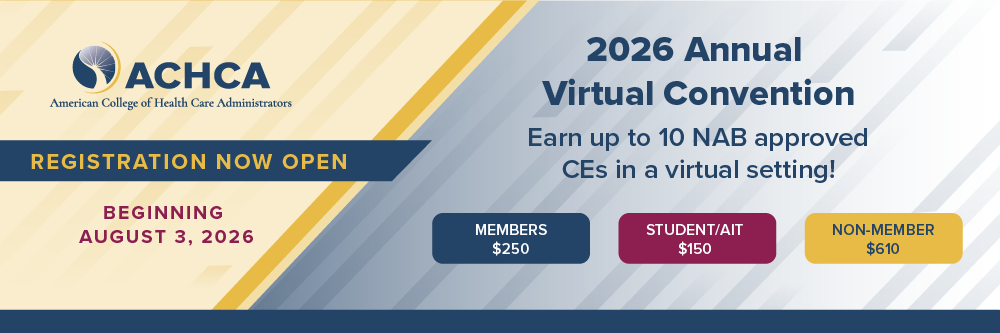
Not able to attend the 2026 ACHCA Convention or missed a presentation? Now you can access select recordings from the live education sessions presented at the 2026 ACHCA Convention in Orlando, FL, and bring the convention learning experience directly to you. Explore timely, practical insights on leadership, compliance, reimbursement, rehabilitation, artificial intelligence, abuse prevention, and other issues shaping the future of long-term and post-acute care. Learn at your own pace, revisit the strategies that matter most, and earn up to 10 continuing education credits along the way.
Start watching beginning August 3 and turn the 2026 ACHCA Convention experience into practical learning wherever you are!
Pricing: ACHCA Members: $250
ACHCA Student/AIT: $150
Non-Member: $610 (includes a complimentary year long ACHCA membership for those who qualify!)
- Convention Welcome and Keynote Presentation: Cultivating Psychological Safety: A Strategic Imperative for Long-Term Care Leadership
Lorne Epstein, SHRM-SCP, MSOD
1 CE
- Abuse Prevention: What Leaders Need to Know
Lisa Thompson, NHA, HSE - Pathway Health Services - 1 CE
Abuse prevention remains one of the most frequently cited areas of noncompliance in skilled nursing facilities, consistently ranking among the top ten F-Tag deficiencies nationwide. This interactive session is designed specifically for Nursing Home Administrators to strengthen their leadership role in ensuring resident safety and compliance. Participants will explore current federal regulatory guidance and the eight essential components of an effective abuse prevention program. Through real-world examples and practical tools, leaders will learn how to evaluate their current systems, identify gaps, and implement strategies that foster a culture of prevention, accountability, and respect. The session will conclude with a review of leadership-focused tools that can be immediately applied to improve internal programs and achieve sustainable, survey-ready results.
- AI in the Healthcare Workplace
Annabelle Howat, HSE - American House - 1 CE
This session will highlight how a community is leveraging personalized wearable technology, in-room sensors, and voice-enabled communication to proactively support resident safety, independence, and engagement. It will also explore how these tools enable our integrated assisted living and memory support neighborhood model, universal worker staffing approach, and accommodations for couples with differing care needs.
- Growing Tomorrow's Leaders: Building Confidence, Competence, and Compassion in Long-Term Care
Lisa Thomson, NHA, HSE - Pathway Health Services - 1 CE
This engaging session is designed to help leaders and emerging leaders in the senior living and long-term care industry strengthen their leadership impact. Participants will explore the key differences between managing and leading, with an emphasis on communication, accountability, and resident-centered care. Through interactive discussions and case-based examples, they will learn strategies for enhancing emotional intelligence, team engagement, and workplace culture. The session will also provide tools for coaching, giving feedback, and fostering accountability across interdisciplinary teams. By the end, participants will complete a personal leadership action plan to guide their professional growth and development. This presentation equips current leaders and new leaders to mentor lead with confidence, compassion, and purpose in the ever-evolving field of senior care.
- Navigating AI in Long-Term Care
Stephanie Acosta - Exacare AI - .75 CE
Artificial intelligence is everywhere—but what does it actually mean for long-term care leaders navigating today’s operational and financial pressures? This session cuts through the buzz to clarify what AI truly is (and isn’t), why it matters now, and how it can deliver measurable value across your organization.
Through practical, real-world examples, we’ll explore how AI is already improving performance in critical areas such as admissions, reimbursement optimization, and workforce staffing. Attendees will gain insight into proven use cases that address capacity challenges, reduce administrative burden, and strengthen financial outcomes.
Finally, this session will equip you with a clear roadmap for action. Learn how to evaluate return on investment, identify high-impact starting points, and outline responsible implementation steps that align with your organization’s strategy, compliance requirements, and culture. You’ll leave with the clarity and confidence to move from curiosity to execution—turning AI from a buzzword into a practical advantage.
- Nursing Home Reimbursement Compliance: Strategies for Accuracy, Integrity, and Success
Alicia Cantinieri, MBA, BSN, RN, CHC, RAC-MT, RAC-CTA, DNS-CT, QCP - Zimmet Healthcare Services Group, LLC -
1.5 CE
The 2024 Comprehensive Error Rate Testing (CERT) report revealed a 17.2% improper payment rate, once again highlighting skilled nursing facilities as leading contributors due to documentation deficiencies. This session examines the crucial relationship between clinical documentation, MDS accuracy, and the integrity of Medicare Part A reimbursement. Through analysis of common audit findings, attendees will learn how to identify patterns of noncompliance, strengthen internal review processes, and prevent costly recoupments. Real-world examples and case studies will provide practical guidance for building a culture of documentation excellence and regulatory readiness. Participants will leave equipped with actionable strategies to promote compliance, safeguard reimbursement, and improve organizational performance in today's complex regulatory environment.
- The Rehabilitation Evolution: Driving Outcomes, Quality, and Clinical Reimbursement Through Integrated Care
Kristi Smith - Celtic Consulting LLC - 1.5 CE
As CMS quality and reimbursement models evolve, rehab departments play a strategic role in outcomes, quality, and reimbursement. This session explores how integrated rehab teams support Five-Star, QRP, and VBP programs, extend impact beyond therapy minutes, and drive measurable clinical and financial results through interdisciplinary alignment.
- What Survey Citations Are in the Top 10 and How to Prevent
Barbara A. Bates, MSN, RAC-CT, DNS-MT, QCP-MT - 1 CE
CMS is currently on hold from completing surveys unless immediate jeopardy, facility closure or serious investigation concerns such as abuse are being considered. Even though the government shutdown is impacting the scheduling of routine surveys, LTC facilities still need to be aware of what citations were occurring at the time of the shutdown to ensure their facilities are in good standing when the survey cycles start back up. Does your facility know what regulatory citations are occurring in the nation? In their individual region or in their state? Do you know where to find them? Does the interdisciplinary team understand how the top 10 deficiencies can be prevented and how the facility can develop proactive systems to address concerns and ensure that the facility staff understands that the prevention process must include the entire team. Please join us in discussing the answers to these questions, identify what survey citations are in the current top ten and find methods to prevent the citations from actually occurring.
- Leadership transition: Transitional Leadership is More Than Just Transitioning Into the Job
Dr. Michael Mileski, PhD, DC, MPH, MSHEd, LNFA, FACHCA - 1.25 CE
Stepping into a leadership role is more than accepting a new title—it’s a critical transition that requires intentional planning, relationship-building, and cultural alignment. Too often, leaders focus only on the operational aspects of their new role, overlooking the human and strategic dimensions that determine long-term success. This session explores the concept of transitional leadership—a process that goes beyond simply “starting the job” to actively shaping vision, trust, and influence from day one. Participants will learn how to navigate the challenges of stepping into a new leadership position, including managing expectations, building credibility, and understanding the existing workplace culture. Through practical strategies and real-world insights, the session highlights key areas such as setting early priorities, communicating effectively, fostering team engagement, and avoiding common missteps that derail new leaders. By the end of the session, participants will be equipped with tools to approach leadership transitions more strategically, ensuring they not only adapt to their new role but also position themselves as effective, respected, and forward-thinking leaders from the very beginning.
|